
Tinto, Odiel and Piedras (Spain)
Climate
The Tinto, Odiel and Piedras (TOP)basinbasin has a dry Mediterranean climate, characterized by hot, dry summers and mild winters with irregular rainfall. The average annual precipitation for the period 1981-2018 is 670 mm (Chirps v2.0, Funk et al., 2015).
Monthly and spatial distribution of rainfall is highly heterogeneous, with rainy months, mainly in autumn, winter and spring and dry summers, with almost no precipitation in summer.
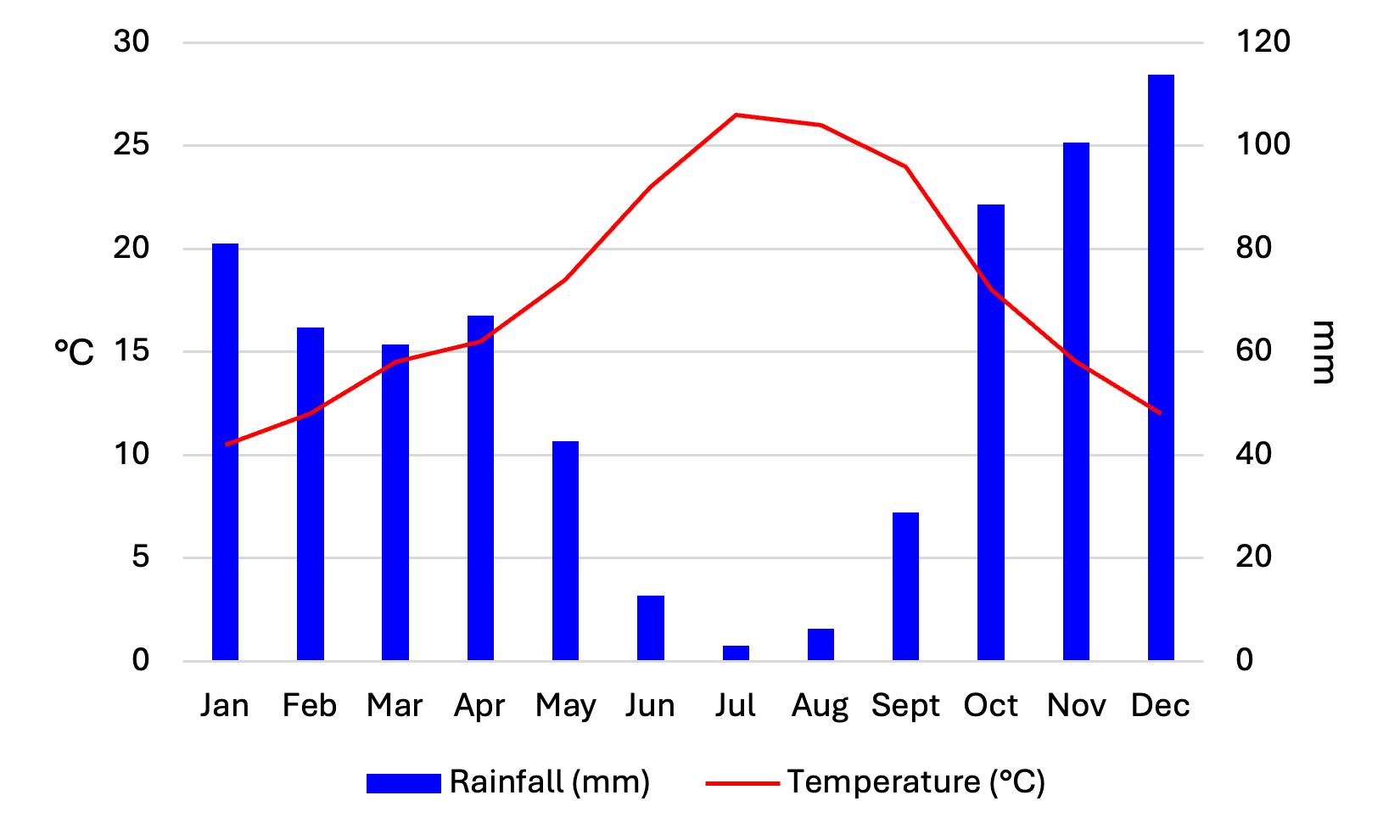
A study conducted in the Guadalquivir Valley, located in the province of Huelva, but outside the TOP basin, that analyses temperature trends indicate an increase ranging from 0.11°C per decade for the mean annual daily maximum temperature to 0.58°C per decade for the mean monthly daily minimum temperature (1973–2016) (Herrera-Grimaldi et al., 2018).
Furthermore this region of Spain is prone to droughts, with drought periods in 1950-1951, 1954, 1957, 1964, 1966-1967, 1972, 1974, 1979-1981, 1990-1995, and 2011–2017. An increase in the frequency and intensity of droughts is projected for Spain, particularly in the southern and southeastern regions of the peninsula as the 21st century progresses (Centro de Estudios Hidrológicos, 2017).
References:
Álvarez, M. J. (2021). La vida tras un desastre: El caso de Nerva, en Huelva.
Brunet, M., Jones, P. D., Sigró, J., Saladié, O., Aguilár, E., Moberg, A., Della-Maarta, P. M., Lister, D., Walther, A., & Lopez, D. (2017). Temporal and spatial temperature variability and change over Spain during 1850 2005.pdf.
Centro de Estudios Hidrológicos. (2017). Evaluación del Impacto del Cambio Climático en los Recursos Hídricos y Sequias en España.
Funk, C., Peterson, P., Landsfeld, M., Pedreros, D., Verdin, J., Shukla, S., Husak, G., Rowland, J., Harrison, L., Hoell, A., & Michaelsen, J. (2015). The climate hazards infrared precipitation with stations—A new environmental record for monitoring extremes [Dataset]. https://doi.org/10.1038/sdata.2015.66
Herrera-Grimaldi, P., García-Marín, A., Ayuso-Muñoz, J. L., Flamini, A., Morbidelli, R., & Ayuso-Ruíz, J. L. (2018). Detection of trends and break points in temperature: The case of Umbria (Italy) and Guadalquivir Valley (Spain). Acta Geophysica, 66(3), 329-343. https://doi.org/10.1007/s11600-018-0118-1